


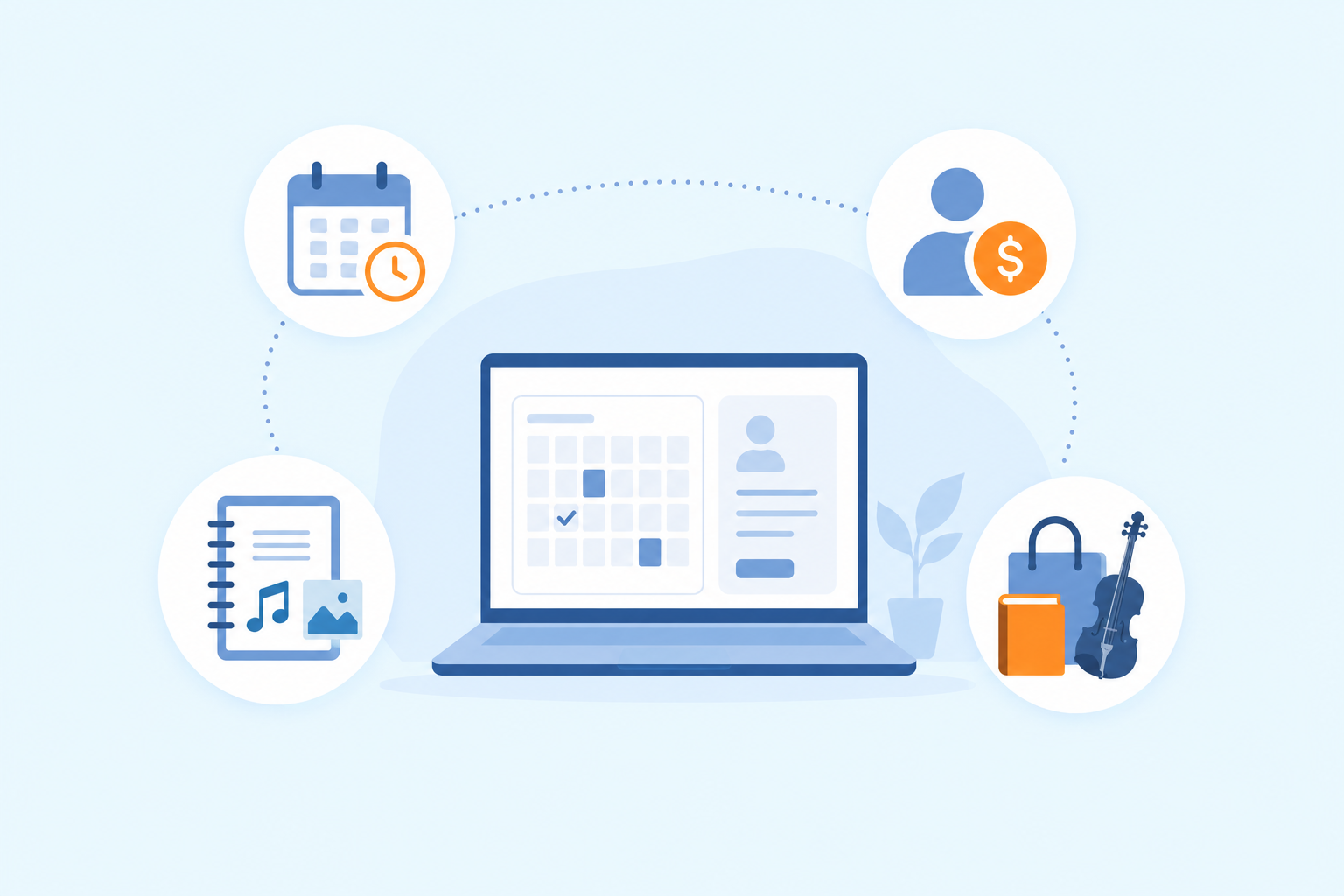
Booking a lesson, taking attendance, sending an invoice — most music school software handles the basics well. Four areas tend to separate a system that fits a growing school from one that needs a workaround: how make-ups are split, how teachers get paid, where practice notes live, and where instrument or book sales happen. None of these are exotic. They just get overlooked until a school hits a specific size or mix of services.
Key takeaways
- Make-ups should split cleanly: one missed lesson into several shorter sessions, each linked back to the original.
- Payroll should combine pay components, not just pick one: base pay, commission, overtime, and allowances calculated together from real lessons, not a single flat method.
- A journal belongs in the same login as billing: teachers shouldn't need a second app just to share a photo or recording.
- Instrument and book sales belong in the same POS as tuition: not a separate retail system.
1. Make-ups that split, not just reschedule
One-on-one lessons make up differently from group classes: a missed 60-minute lesson often needs to become two 30-minute sessions, not one full replacement slot booked days later.
In SchoolTracs, a missed lesson can be split into several shorter make-up sessions, each automatically linked back to the original — see our full make-up lesson guide for the complete workflow. Not every scheduling tool can split into sub-hour increments; see our software comparison for how specific vendors handle it.
2. Payroll that combines more than one pay component
A flat hourly rate or a straight commission is easy for most systems to calculate. The gap shows up once a teacher's contract needs more than one component at once — for example, a base salary plus lesson commission plus a statutory pension contribution.
In SchoolTracs, teacher pay can combine a fixed or hourly base with lesson commissions, overtime, insurance, pension, bonuses, and allowances by percentage, calculated automatically from actual lessons and attendance. See our tutor payroll models guide for how the different methods compare, and our software comparison for what other tools support.
3. A practice journal in the same system as billing
Teachers shouldn't need a second login just to share a photo or a recording after a lesson. If practice tracking lives in a separate app from attendance and fees, it's one more thing that gets skipped on a busy day.
- Upload a photo or audio clip right after the lesson — no second login.
- AI assist turns quick notes into a written entry.
- Parents see it immediately in the Student App.
- Entries roll up into a 3-to-6-month progress report for recitals or reviews.
If deep practice tooling — slow-down/speed-up playback, a private video library — is the priority, a specialist app will out-feature a general system; see the comparison for specifics.
4. Instrument and sheet music sales, one POS
A school that rents violins or sells method books usually ends up running a second cash register unless the scheduling system also handles retail. That's a gap that's easy to overlook until it means reconciling two systems every month.
- Multi-branch inventory for books, accessories, and other stocked items.
- Automatic stock deduction on sale, and transfers between branches.
- All inside the same system used for tuition invoicing.
To be precise: this is general retail inventory, not a specialised instrument-serial or rental-tracking system. A complex rental program with warranty-by-serial-number tracking may still need a specialist tool for that one piece — see the comparison for where that line sits. For selling books, strings, and accessories alongside lesson fees, one system covers it.
Questions to ask any vendor
- Can a missed one-on-one lesson split into more than one make-up, staying linked to the original?
- What's the smallest time increment a lesson or make-up can be scheduled in?
- Can payroll combine a base rate with commission, overtime, and allowances — or only one method at a time?
- Can a teacher upload a photo or recording without leaving the attendance/billing app?
- Do instrument, book, or accessory sales run through the same POS as tuition — or a separate system?
- If separate, what does running both cost, and who reconciles them?
- Is inventory tracked per branch, with real-time updates on transfer?
What this looks like in practice
Hong Kong Harp Chamber Music, established 2005, runs harp lessons, performances, instrument sales/hire, books, accessories, and repairs across two branches.
- Before SchoolTracs: scheduling and attendance on paper, which stopped scaling as enrolment grew.
- After: both branches share one schedule; students log their own attendance via the app.
- Instrument and book sales run through the same POS as tuition, with stock staying accurate wherever a sale happens.
- When remote work became necessary, records were already centralised — nothing to rebuild.
Want to see whether one system covers your school's mix of lessons, payroll, journals, and retail? See how SchoolTracs works for music schools, or start a free trial with your own timetable and fee structure. For a sourced, vendor-by-vendor look at how My Music Staff, Fons, Teachworks, and specialist practice and retail tools handle each of these four areas, see our music school software comparison.
Frequently asked questions
What should music school software handle beyond basic lesson scheduling?
Four things in particular: splitting a missed lesson into more than one make-up, calculating teacher payroll from more than one pay component at once, logging practice notes in the same system used for billing, and selling or renting instruments and sheet music through the same POS as tuition. See our vendor-by-vendor comparison for how specific tools measure up on each.
Can a missed lesson be split into more than one make-up session?
Yes. In SchoolTracs, a missed lesson can be split into several shorter make-up sessions, each linked back to the original — see our full guide on handling make-up lessons and rescheduling.
Can teacher payroll combine a base salary with commission, overtime, and allowances?
Yes. In SchoolTracs, teacher pay can combine a fixed or hourly base with lesson commissions, overtime, insurance, pension, bonuses, and allowances, calculated automatically from actual lessons and attendance.
Can a music school track instrument and sheet music inventory in the same system as tuition?
Yes — multi-branch inventory for books, accessories, and other stocked items, with automatic stock deduction and branch transfers, inside the same POS used for tuition fees.